
Saint Martin of Tours: A Patron Saint of France

Will Alkass describes the life and work of one of France's most important Saints

Martin was born in 336 A.D. to a non-Christian family in Pannonia (the present day territory of Hungary, Croatia and Austria). At the age of ten he turned to Christ and despite the protests of his parents became a catechumen at a local Christian community; a 'catechumen', especially in the early Church, was a person who was undergoing instruction prior to baptism. Martin's father was a Roman military tribune and that is why his son, when he was fifteen, was called for military service in the Roman army. Martin served in Gaul (present day France) and had the rank of an officer.

It was during his military service in Amiens that St Martin did one of his most well-known deeds:
He cut his cape with a sword and gave a half of it to the almost naked homeless person suffering from winter cold. As is said in the life story of the saint, when Martin fell asleep that day, he saw Christ in a dream, dressed in the very cape that Martin had given to the poor man, and then in the dream Christ told His angels: “It was Martin who dressed me in this vestment, although he is just a catechumen”.
That dream strengthened Martin’s faith, and at the age of eighteen he left his military career, risking arrest because of his unwillingness to fight in a forthcoming war. He began to preach Christian faith and more than once was exiled from various cities by 'Arian' bishops, who rejected the traditional notion of Trinity; but his steadfastness in faith won the day, preferring peaceful demonstration rather than violent or ferocious means of confronting his adversaries and opponents.
Later he would become a disciple of St. Hilary of Poitiers, the great and well-known theologian of the West; under his guidance founded a monastery not far from Poitiers which soon gathered a whole new monastic community that went on to become a breeding ground for monasticism in Gaul.
St Martin went on to perform many miraculous acts of healing the sick, curing the demonised and baptising converts. Then in 371 he was chosen against his will as Bishop of the city of Tours. The citizens had been very inspired by his way of life so they asked Martin to come to Tours under the guise of praying for a severely ill person. According to one version, when Martin found out that the real reason they had invited him was to make him their bishop, he tried to hide in a shed full of geese; however, this did not work out as the geese in the shed began to gabble and make so much noise that it was easy for the people to find Martin there. Martin looked so torn and messy after his unsuccessful attempt to escape, that his critics claimed he was not worthy of the rank of a bishop, but nevertheless the majority of people insisted. As a bishop, Martin paid much attention to the spreading of Bible and the local evangelization of the predominantly pagan citizens, as well as being really kind towards the poor and caring a lot about the sick and hungry. For this reason he was called “The Merciful”. When Martin became a bishop he did not forget his monastic ideals and moved from the city to the monastery of Marmoutier not far from Tours, residing in a simple cell while establishing strict rules of asceticism there.
St. Martin devoted so much time and effort to rescuing the imprisoned, that when authorities heard he was going to visit them they refused to meet him since they knew he would ask them to have mercy on their prisoners and knew that they could not refuse. He became one of the most honoured saints in the West. Thousands of churches have been named in his honour and he is celebrated as the patron saint for soldiers and of France. In every church that is dedicated to him, the message of Jesus continues to live: “whatever you did for the least of these of mine, you did for me”

St Martin died in the year 400 at the ripe old age of eighty-one; he was one of the early saints who did not die as a martyr. He was buried in a basilica which was, sadly, burned, ransacked and destroyed several times; firstly by the Norman Vikings in 853 and subsequently by the Protestant Huguenots in 1562.
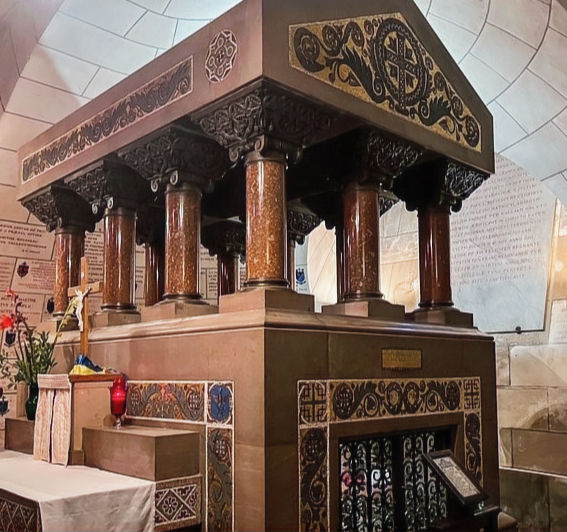
When the tomb of Saint Martin was discovered in 1860, a new basilica was built in his honour with an impressive tomb. The work started in 1886 and the basilica was consecrated on 4th July1925. His resting place is now a site of pilgrimage and his feast day is celebrated on 11th November, which coincidentally is the same day the armistice is celebrated.
So, how significant was St Martin's work and legacy?
Saint Martin was one of three early pioneers who are credited with establishing monastic life in France and subsequently in western europe. Each one of these three contributed a different dimension:
• St. Martin brought the eremitic and communal model that he had experienced through Athanasius’ influence.
• St. Cassian transmitted Egyptian desert spirituality and wisdom, providing written frameworks that shaped Western monasticism.
• St. Hilary provided the institutional and theological support that allowed monastic life to take root.
Together, they laid the foundation for what would subsequently become the monastic landscape of medieval Europe.
Today, there are more than one thousand churches in France named in St Martin's honour; this is not surprising giving that he was a saint rooted in French soil. He established one of the earliest and most powerful centres of monasticism in Marmoutier, which rivalled Rome in the early Middle Ages as a destination for pilgrims seeking healing, protection and intercession; this constant flow of travellers spread his fame across the continent. He was also a Saint and protector of soldiers (having been one himself) and of kings and kingdoms, particularly the Merovingian and Carolingian kings. Thus it was natural that such a saint, with local roots, compassion, humility, courage, healing powers and universal resonance, would have his influence spread far and wide across continental Europe. In fact, his name became part of the cultural fabric of France in a way matched only by Saint Denis and the Virgin Mary.

In England, his influence was established via Queen Bertha of Kent and the early Anglo-Saxon church. Across England, the dedications to St Martin are clustered in Kent (due to the Canterbury connection), Sussex, the Midlands and Yorkshire, where it is estimated that there are up to two hundred parish churches and eighty chapels named in his honour. The most notable of these is St Martin's Church in Canterbury, the oldest church in continuous use in the English-speaking world. It was the private chapel of Queen Bertha of Kent, a Christian Frankish princess who married the pagan King Æthelberht of Kent and who was instrumental in paving the way for the Christianisation of Anglo-Saxon England, even before the arrival of Augustine on his mission from Rome.
England’s Christianisation was later than in France and more centralised, resulting in fewer dedications to Martin than in France, along with strong demand for dedications to local saints such as Cuthbert, Edmund, Edward and Oswald. The Reformation in England in the sixteenth century also resulted in many chapels and churches being destroyed and suppressed.

Another notable dedication example is that of our own local church in England in Maidstone, Kent. Detling parish church, a Grade I listed building, is dedicated to Saint Martin of Tours. The Normans built the nave and chancel in the 12th century with additions and extensions in the 13th and 15th centuries. It's situated along the pilgrims route, the route followed by pilgrims on their way from London to Canterbury.
Another most remarkable example is Saint Martin -in-The-Fields Church in the heart of London. It was built outside the city walls on the site of Roman and Saxon burial grounds under King Henry VIII in 1542, enlarged in 1607 but demolished and replaced with its current structure in 1726 by the Scottish Architect James Gibb, giving it one of the most influential church designs in the English-speaking world. It remains a living symbol of London’s life, thanks to its wide involvement in the fields of charity, arts, music and social life, as well as religious ceremonies.


