
Reverend William Armstrong Buck: The Sporting Priest (1864 -1947)

Historian Judit Kiraly who heads the English-American Library in Nice has written this interesting article about one of the former Chaplains of Holy Trinity Nice.
Many different priests have served the English-speaking community in Nice. Some were hardliners, like Childers and Letts, others were gentle and artistic like Lacy Hulbert, Langford or Ward, but there has only ever been one sportsman: Armstrong Buck, the “sporting priest” of Holy Trinity. This energetic and very positive clergyman promoted education in the old-fashioned British sense; intellectual studies including sport and physical education in the curriculum to form the character of young boys. Armstrong Buck’s name was linked to various local sporting clubs wherever he worked.
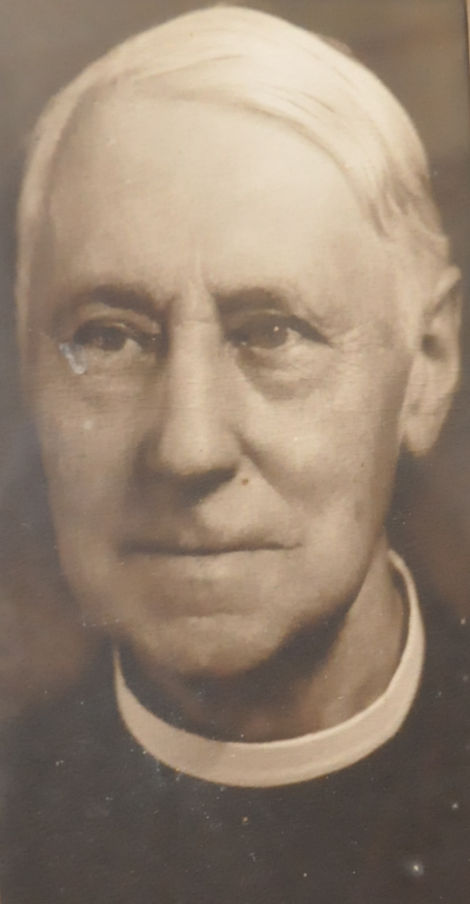
Armstrong Buck was born in West Ham on 2nd of July 1864, the eldest of ten children. His father William R. Buck had worked as a clerk at the War Office and was secretary of the Shipwreck Mariners Society. The young William earned a scholarship and was educated at Peterhouse College, Cambridge, obtaining his BA in 1886, his M.A. in 1890 and in 1887 was ordained Deacon. A year later in 1888, he was ordained priest in London. During his university years he practiced every sport possible: tennis, cricket, rowing, rugby and football. It is not known when he started using Armstrong Buck instead of Buck as an official surname.
His first position was in Bethnal Green, then subsequently in West Hackney at the Merchant Taylor’s School Mission, where he himself had been schooled. He worked there as 'M.T.S. Missioner' from 1890-95. In 1893 he married Agnes Thompson who was the daughter, granddaughter and sister of clergymen. The wedding was conducted by the groom’s grandfather and was truly a clerical wedding. The couple had four daughters and a son who sadly died at a very young age.
William found great personal fulfilment in his next post in Colombo, Sri Lanka, where he was Warden of the excellent St Thomas’s College at Mount Lavinia from1896 to 1901. The family then returned to Europe on account of Mrs Buck’s ill health, and much to William's regret he was never return to Colombo. Today we might view some of his approaches in the school in a different light given that he encouraged ‘manly behaviour’ and corporal punishment, but the school was at the time very appreciative of his involvement in all levels of education and at the College today has a Buck House named after him. St Thomas’s College was a rather original Anglican school; according to its website: “Christian values were the corner stone on which the school was founded. Students of all races and religions studied in harmony”. The Reverend Armstrong Buck organised many special events during his spare time: he was active as President and later Vice-President of the Colombo Croquet Club, surprisingly even after his return to England.
His work is well remembered in the school and it is interesting to read the following extracts from the school’s website which underline the modernity and open-minded attitude of Armstong Buck, who was subsequently to spend over fifteen years looking after the English-speaking congregation of Holy Trinity Nice:
The Times of Warden Buck
On September 28th 1896, Warden Buck landed in Colombo and was hauled up the College drive in his carriage by the boys, according to the custom of the time. … He had a fine athletic record, having been captain of his School, College and County Rugby football teams, and having played cricket for the Gentlemen of Essex. He was also a good fives and tennis player, an oarsman, and an athlete. He was at this time a young man of thirty-two, full of energy and enthusiasm. Although his stay in Ceylon was to be even shorter than that of his predecessor, the College has seldom been through a more stirring period. The new Warden set to work at once upon new schemes of improvement. Before the end of the year he had sent away a number of boys who were unfit for the standard of work of the College; had started a vigorous repairing of the building, to which the Old Boys contributed 10,000 rupee; and had raised the numbers in the Boarding Houses to 90, which was the highest point that had been reached for some years … By the end of May, a new dormitory had been built on the site of the old Orphanage to accommodate the ever-increasing number of boarders, and the cricket field had been planted with grass anew and was ready for play in August.
With the extension of the Cricket field came the first "Inter-Dormitory" Cricket Matches. …May 1897 saw a Football Club started for the first time. It led a very precarious life for many months to come, before it became permanently established …This same period saw the revival of the swimming races, this time in the harbour.........…Early in 1901 the Warden was on leave, and by May, the news arrived that, owing to the ill health of his wife, he had been compelled to resign. He had gone to England full of plans for the celebration of the College Jubilee, which he had hoped to return and carry out. One of his plans was to found and endow the scholarship in memory of Bishop Chapman, which has already been mentioned.
Warden Buck may certainly claim a high place among the distinguished men who have guided the destinies of the College, and his untimely departure was greatly to be regretted. "We have only to look round the College premises" says the Editor of the Magazine, "to see the improvements effected on all sides - the Cathedral, Dormitories, the School Rooms, the Cricket pitch, the Fives courts, the Tennis court, and the Gymnasium, the eye cannot alight on any part of the compound without coming across some evidence of the ceaseless activity of the Warden." With his enthusiasm and outspoken criticism, and his energetic nature he achieved a great deal during his four years of office. He was a good preacher and spoke with great humour and pith and at functions. He loved the School with a whole-hearted affection and did everything in his power for its welfare.
William Armstrong Buck's farewell letter to his boys is also of interest as it shows something of his character, and his remarkable enthusiasm: 'My dear Boys, I little thought that when I bade you all

farewell in December and heard your ringing cheers as you came to see me off I should not be returning again to Colombo; but as you know, such is the case. The doctors quite forbid Mrs. Buck to return to the tropics, as it would have been too serious a risk after her collapse last year; and as the Bishop of London, Dr. Winnington-Ingram, offered me a large and important living in London some weeks ago, I thought it was the best and wisest thing to accept it. I did so, however, with great reluctance, and only after very anxious deliberation, as I could not bear the thought of not seeing the dear old College again, especially as I was eager to pioneer it through the Jubilee, and to see the scholarship fund well started, but this I must now leave to my successor and to all of you, and I do earnestly trust that you will, each and all, do your utmost to make the Jubilee a thorough success, and to raise for the scholarship a sum worthy of S.T.C.
I have to thank you all very warmly for the kindness and affection you showed to Mrs. Buck and myself during our four years in Colombo, and for the generous way you backed up whatever I tried to do for the good of the College. I have had a very happy life for thirty six years, but both Mrs. Buck and myself feel that our days at S.T.C have been the happiest we have ever spent, and it is a great wrench and a real sorrow to us to have to say good-bye now. I shall never forget the College and the Cathedral and shall always remember you and your welfare in my prayers; and whenever any of you come to England, I shall look forward to seeing you in our new home, and helping you in any way that I can.
Now I must give you a few words of parting advice. You belong to one of the best schools in the world, a school with splendid traditions and a most honourable name, and I charge you to try and hand down those traditions and that name to those who come after you, untarnished and unimpaired. Be proud of being Thomians and make the College proud of numbering you among its sons. Remember that whatever you do and wherever you go, your life and your actions will reflect either credit or discredit on the College where you were trained, and to which you owe so much. You have learned the best lessons in the world at S.T.C. I trust; not only English and Classics and Mathematics, but true manliness and truth, courage, purity, and all those things that make a man, and a gentleman. Try never to forget them, but be men and gentlemen always. Be loyal to your new Warden whoever he may be, and to all your masters who are working their best for you and the College. Above all be loyal to God, and to what you know is right. And now I must say good-bye. God bless you all and everything connected with St.Thomas’, now and ever.
Yours gratefully and affectionately,W. Armstrong Buck, The Vicarage, Stoke Newington, London. 2nd May, 1901.
Armstong Buck was appointed Vicar at Leamington in central England, where he officiated from 1907 to 1916, and from 1906 he was also Vice President of the Leamington Cricket Club.

During his stay in Leamington, the Reverend actively campaigned to improve the living conditions of the poor, since people were still living in terrible squalor in its slum areas in the early twentieth century. Nor was he was shy in voicing his opinion and sending letters to local papers about various problems along with his suggestions. In July 1912, The Leamington Spa Courrier printed his letters following an official survey which pointed out the unacceptable conditions. He had many clashes with the Local Council, which were all reported in the local paper.
In December 1906, he held a special service “for men” concerning gambling and dishonesty. He had no inkling then, that some years later he would be looking after a church located in the capital of gambling, Monaco. In April 1908, he complained (via The Cheltenham Chronicle) that ‘immoral’ songs were sung during a municipal concert; when he had an opinion he voiced it.
In November 1908, he lost his beloved first wife aged only forty. Mrs Buck was involved in many associations and much appreciated by the community and great numbers attended her funeral.
Armstrong Buck continued to work and travel: in December 1910 he gave a series of talks about the Oberammergau Passion Play that he had attended, which were illustrated by his own slides. He was an excellent speaker who did not rely on using notes and these talks were very popular indeed.
In 1915, during the First World War, Armstrong Buck wrote about the importance of the three million enlisted men who were in the nation's service to protect their country; he chided those young, single men who did not enlist while some married men did so with no hesitation.
From Leamington he moved to Pau in south west France (1919-20), but then was put in charge of the wealthy congregation of Monte Carlo (1920-22). This proved to be a very busy time for him as he also supervised the construction of the brand-new building that was being built for the English-speaking community there, St Paul’s. During his stay in Monte Carlo, Armstrong Buck supervised not only church activities, but also various collections to maintain and improve the final construction works. The church was built on difficult, sloping terrain and the costly building and interior arrangements required funds to cover such expenses. St Paul’s Church was built by the father and son team of Aaron and Gaston Messiah who had already built Holy Trinity Presbytery in Nice and the “English” Protestant Church in Beaulieu, even though they themselves were practising Jews. During his stay in Monaco, he played the piano at numerous charitable musical events; (when he later moved to the large and spacious presbytery in Nice, he continued this tradition even more). He was an accomplished amateur pianist and at one time had been a student of Clara Schumann (Menton and Monte Carlo News, 2 January 1926)
After Monaco, Armstrong Buck moved to Holy Trinity Nice (1922-1937) where he stayed for fifteen years, his longest stay in any post. The Reverend Armstrong Buck was a very popular priest; Holy Trinity was always well-attended during his years in Nice. The Reverend was a member of many associations and active member of numerous cultural and sporting committees. He was an avid fan of all sports, especially tennis and football. He organised and attended many concerts, some of them for fundraising, both in Monaco and in Nice.
William had a happy second marriage lasting over three decades to Hilda Mary (Cherry) Buck who passed away in 1937 (aged sixty three in Leamington Spa; her husband outlived her by twelve years they had no children together.
One of the last church services William conducted was in Leamington on the 17th of October 1938, for Thanksgiving Day. In his speech he thanked the Prime Minister for avoiding the dark clouds of War coming over the country again. Unfortunately for Britain and for Europe, he was mistaken and another terrible war was about to break out (one of Buck’s brothers was amongst the many killed). The Reverend Armstrong Buck was a very popular clergyman as well as a kind and caring educator. He lived his final years in London, where he died in 1947. He sprinted through his eight decades and arrived at the finish line with excellent results.
Sources: Holy Trinity Anglican Church Nice, accounting archives, The Menton and Monte Carlo News available on the Bibliothèque Nationale site: gallica.fr, The British Newspaper Library online , London Remembers, St Thomas’ College, Mount Lavinia website
Judit Kiraly
English- American Library of Nice

