
Montenegro, a must-see for nature and history lovers

Our regular contributor Will Alkass has recently made a trip with his wife Hannah to explore Montenegro and its churches and monasteries.
Montenegro is a small country, with a surface area of 13,883 square kilometers; it is a bit smaller than Northern Ireland or the state of Connecticut and is the smallest of the six countries that formed the former Yugoslavia. Its name derives from the fact that there are lots of mountains covered with dense forests of black pines which give the impression of "black mountains". My wife and I spent fourteen days touring the country in September, which is probably the best time to visit as the weather is just right and there are not many tourists around.
Montenegro boasts a wealth of natural resources and places of interest that will surprise the most intrepid traveller and rival the most beautiful places in Europe. It has mountains and hills with quaint villages, valleys and gorges, lakes and forests, and a wide stretch of beautiful beaches along the Adriatic sea, as well as my special area of interest namely the historical sites, churches and monasteries, of which there are plenty. Of notable mention is the Tara river gorge which is the deepest gorge in Europe and the third deepest in the world after the Sulak Canyon in Dagestan, and the Grand Canyon in Arizona.

The gorge lies within the Dormitor Natural Reserve in the north of the country is known as "the tear of Europe" and extends for 82 km and measures 1.3 km deep; it boasts many rapids along parts of the river which provide exciting opportunities for rafting enthusiasts.

The canyon can be crossed by the Durdevika Tara bridge which was constructed between 1937 and 1940. At the time it was the biggest vehicular concrete bridge in Europe. Part of the bridge was blown up by partisans during the Italian occupation of Yugoslavia during World War II to prevent their further advance but was rebuilt in 1946. The views from the bridge and along the course of the river are breathtaking.
If the Eiffel Tower is the symbol of Paris, and Big Ben, Saint Paul's Cathedral and the Tower Bridge the symbols of London and England, then for Montenegro the two most recognisable symbols are the town of Kotor and the village of Sveti Stefan. More on that later!
HISTORICAL NOTE
Both the geographical position and the terrain of the country have been a mixed blessing for the country and its people. It had been the target of invasions and occupations by successive larger powers, with the local Slavic population enduring dominance by the Byzantine Empire followed by the Serbian Empire and latterly by the Ottoman Empire. Even though there were many competing clans within the country, they were also able at times to unite and fight off these intruding powers.
The Montenegrin suffered the most when trying to resist the Ottoman advances against which many battles were fought; some were lost but others were won in part thanks to the rugged and difficult terrain, along with the people's determination to retain their traditions, laws and religion. This same geography and difficult terrain was nevertheless also a hindrance to the country's progression and development due to its isolation, difficulties in communication, and limited access to broader networks of trade and influence. Although the Ottomans may have in theory controlled the area, in practice the clans retained significant autonomy, conducting guerrilla warfare to defend their freedom and independence.
The nation was evangelised along with other Slavic nations, by the brothers Cyril and Methodius in the 9th century. A unique style of governance developed in Montenegro, that of "Vladica" or the Prince-Bishop, where the same ruler would at the same time be the spiritual leader and the secular governor of the principality, thus combining faith and governance. The many monasteries and churches that were constructed during these times served not only as places of worship, but also as centres of unity and cohesion for the people, raising their nationalistic fervour during dangerous times.
There have been many distinguished figures in the country's tumultuous history but one notable personality is that of King Nikola I Petrović, who served as Prince from 1860 to 1910 and then as the first and last king from 1910 to 1918. He was pivotal in advancing the country's cause in many spheres, but when Serbia and Montenegro were defeated by the Austro-Hungarian Empire in 1916, he fled to France and eventually died in Antibes as an exiled king. Two of his grandsons also became kings: Alexander I of Yugoslavia and Umberto II of Italy.
MONASTERIES AND CHURCHES
The religious landscape of Montenegro reflects its history. About seventy one percent of the population belong to the Eastern Orthodox Church. The remainder are either followers of the Roman Catholic Church, Islam or Judaism.
Certain universal features of Eastern Orthodox churches and monasteries are worth noting here:

THE ICONSTASIS
This is one of the most important architectural features of Orthodox churches. It is an unbroken screen of icons that separates the sanctuary where the Eucharist is celebrated, from the central the nave where the congregation stands. It consists of several rows of icons placed on horizontal wooden transoms broken by a set of doors in the centre (the Holy or Royal doors) and a door on each side (the Deacon's doors). The use of icons is central to worship, with them treated not only as religious art but also as a sacramental medium through which worshippers commune with the divine. On either side of the Royal Doors are placed an icon of the Saviour (to the right) and of the Most Holy Theotokos (or the Virgin) with the baby (to the left). Above this level are usually two, three, or four horizontal rows of icons representing the archangels Michael and Gabriel, the Apostles Peter and Paul, and other saints and martyrs. The top levels usually contain icons of the old Testament prophets and local religious figures.

THE RUSSIAN or ORTHODOX CROSS
This image dates back to the 16th century and characteristically has three horizontal crossbeams with the top one representing “Jesus of Nazareth, King of the Jews”, the middle one representing the crucifix's beam upon which Jesus arms were fixed, and the bottom slanted beam representing the two criminals crucified on either side of Jesus, with the top end representing the penitent thief and the bottom end representing the impenitent thief.

LIGHTING CANDLES
As in western churches, lighting candles is traditional during worship. The custom of lighting lamps arose a long time ago in the first centuries of Christianity. Christians were persecuted at times for confessing their faith and might gather to pray secretly at night. Candles began to be lit not only to illuminate the room but also to express spiritual joy and triumph. Candles are also lit to accompany personal prayers; a special candle stand or "Ehivhis" is dedicated to this and usually consists of two levels. The upper level is devoted to the “living” (if you are praying for a cure or for healing or to express thanks for yourself or another person) while the bottom level is dedicated to the “dead” (when praying for the departed souls of loved ones).
Ostrog Monastery

This picture shows only the front façade of this monastery; all the other chambers and churches and monks' dwellings lie behind it carved into the hill at an altitude of nine hundred meters.
It was founded by Saint Basil of Ostrog in 1665 and is considered one of the largest pilgrimage sites in Europe. You can file past the open coffin of St Basil The Miracle Worker, in a chamber adorned with frescoes of unrivalled beauty, made of mosaics that cover the curved walls and ceilings. According to the tales of pilgrims, many have been cured and helped in their troubles by praying next to the body of St Basil of Ostrog, There are rooms available for pilgrims to stay.
From Ostrog monastery: A mosaic and frescoes of Saint Sava, and of the baptism of Christ
Zdrebaonik Monastery

Not far from Ostrog Monastery lies this female Serbian Orthodox monastery where many nuns live. It was built in 1818 and is dedicated to John the Baptist. It plays a central role in their religious life and is especially significant for preserving relics of many female saints; since 1920 it has held the relics of the Archbishop Arsenije Sremac who succeeded Saint Sava, founder of the Serbian Orthodoxy.
The hospice house of 1819 is a beautiful two-storey building made in a strict classical style. The lower floor rooms are reserved for pilgrims to stay the night, while on the second floor are the rooms of the nuns themselves.
Centinje Monastery

This monastery is located near the city of Cetinje, the old capital of Montenegro.
It was built in 1484 and houses the relics of Saint Peter of Cetinje as well as the hand of Saint John the Baptist, a fragment of the true Cross and the episcopal cloth of Saint Sava from the 13th century. In addition, it also houses many artefacts that are important in the history of the country. It also served as the seat of all the rulers of the Petrovic Dynasty.
Saint Sava Monastery

This is also known as Savina monastery and is located within half an hour's uphill walk from the city of the Herceg Novi on Kotor Bay. It consists of three parts and a small museum. There is the church or temple of Saint Sava which was built by St Sava, the small church of the Assumption (or church of the Dormition) which dates from 1030, and the Great Temple of the Assumption which was built between the 1777 and 1799.
You can end your visit with a detour to the Savina Winery where you can taste and buy some locally produced wine.
OTHER PLACES OF INTEREST:
Sveti Stefan

This small island some six km south of Budva, is connected to the mainland by a narrow causeway. It used to be the domain of a rich family but later became a Venetian protectorate. There was a period when the island fell into disrepair with a depleted population, but under the Yugoslav government it was turned into a leisure complex. More recently it has been developed into a five-star franchise of the international group Aman Resorts and is therefore not accessible to the public.
Kotor
The city of Kotor which is a UNESCO World Heritage site, has a very interesting history and was ruled at times by various kingdoms and dynasties: beginning with the Byzantine empire, then the medieval Serbian state, Hungary and Bosnia. In 1420 the local leaders then handed over control of the city to the Venetian Republic to help protect its independence from the advancing Ottoman empire. This hegemony lasted for four hundred years and its influence can still be felt and seen

today in the immense defences built around the city, the magnificent italian-style architecture and the many roman catholic churches in a land otherwise dominated by the Serbian Orthodox church.
In 1797 it was the turn of the Austrian Empire to assume authority for another hundred years. Finally and after occupations by the French, the Italian and the Nazis, the whole of Montenegro was liberated in 1944 and went into a federal union with Serbia, Croatia and Slovenia to form the Federal Republic of Yugoslavia under General Tito.
Four centuries of Venetian domination from 1420 to 1797 have given the city its typical Venetian architecture. It is one of the best preserved medieval old towns on the Adriatic and is home to numerous sights, such as the Cathedral of Saint Tryphon (1166) in the old town; it is one of two Roman Catholic cathedrals in Montenegro and contains some invaluable frescoes and a treasury. Saint Tryphon (whose local name is Sveti Tripun) was a third century martyr from Anatolia who was subsequently adopted as the patron and protector of Kotor.
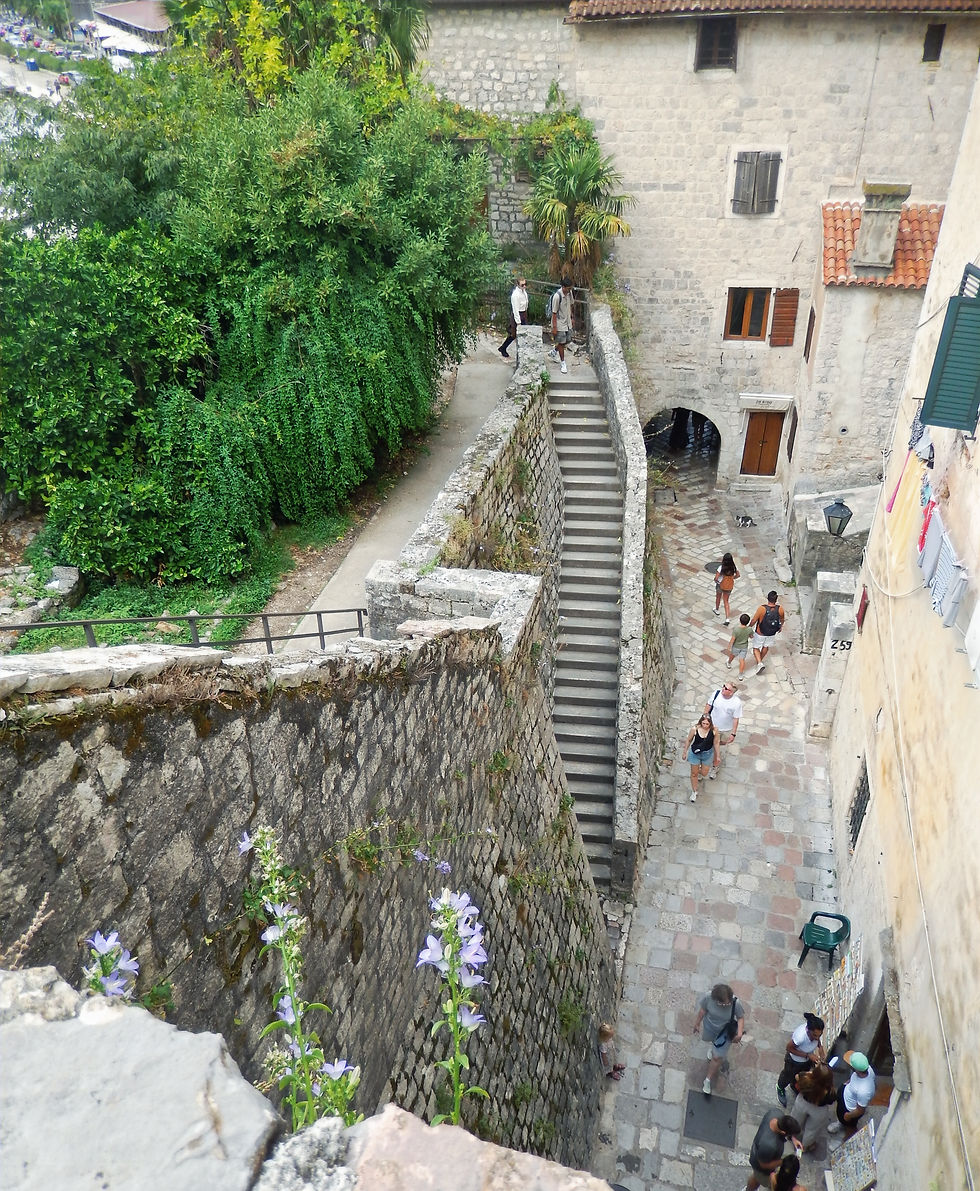
You can walk the ancient defensive walls that surround the city for a length of four and a half kilometers. These magnificent structures incorporate military architecture that was started by the Illyrians, followed by the Byzantines, the Venetians and lastly the Austrians.
The town has become a magnet for tourists. Cruise ships visit the city all year round, leading to a plethora of tourist shops, hotels, cafes and restaurants. However, the daily market selling local fresh produce still retains its old charm.


